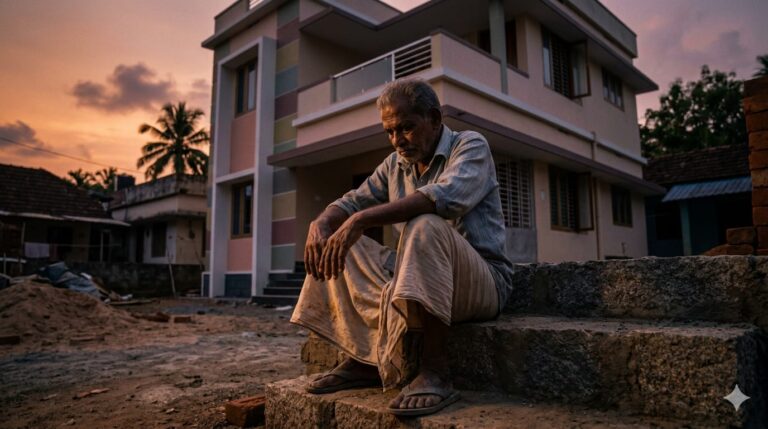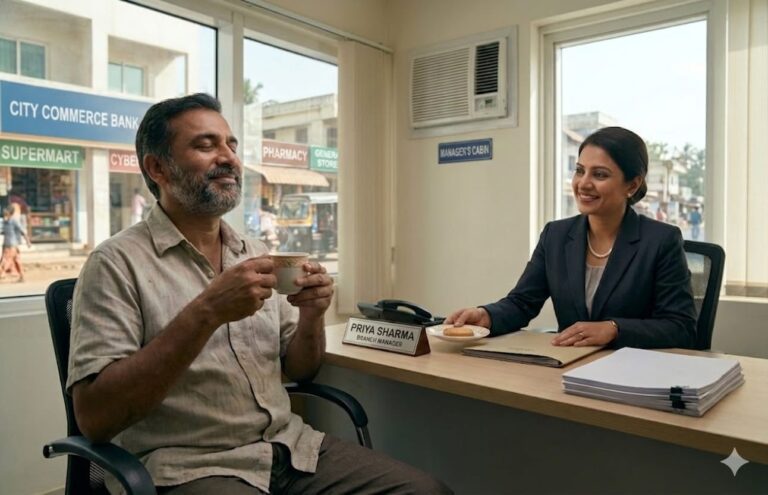
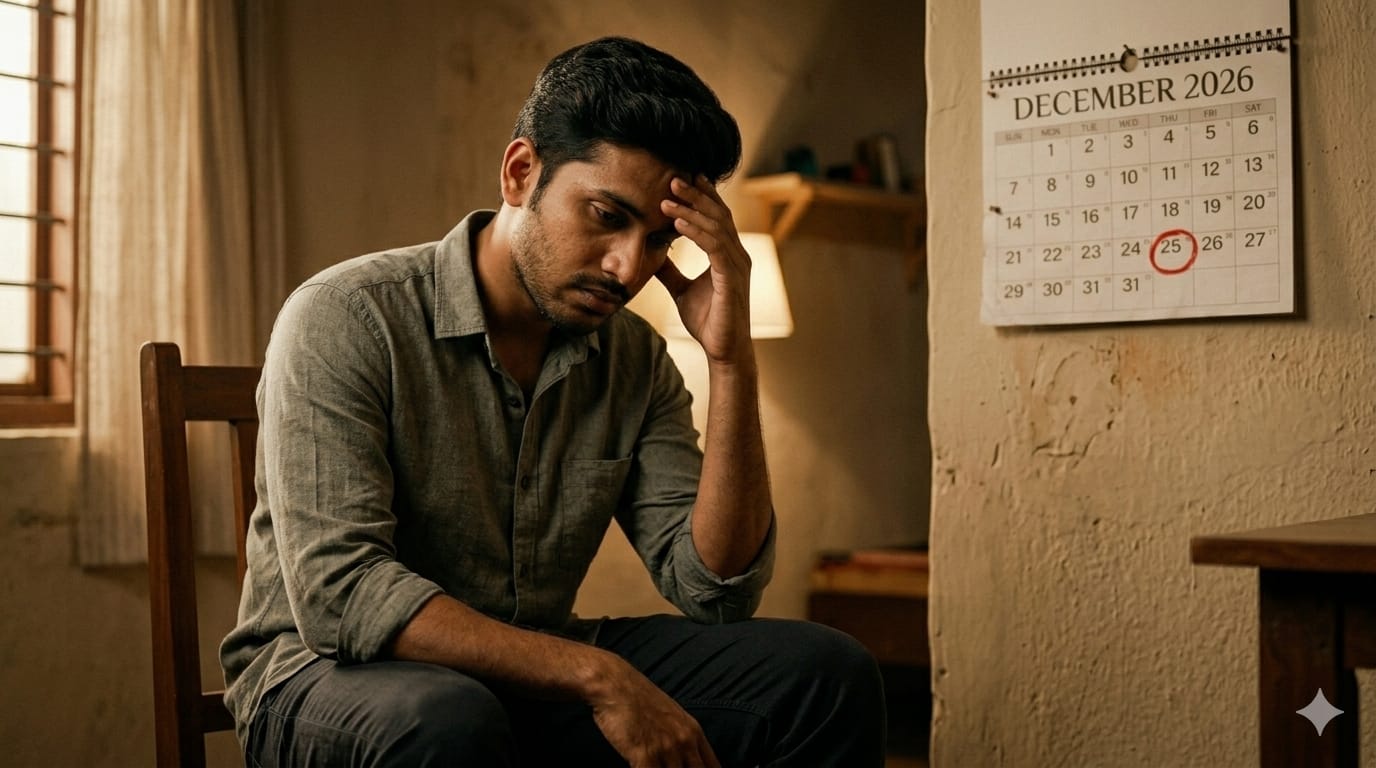
The Neo Poor-Educated.Employed.Broke
“Paisa Stories-Where Small Things Change Your Financial Reality”– THE NEO POOR TRAP
In Article 3, Rohan updated his father’s inherited notebook, updated the rulebook, and started a ₹1,000 SIP — feeling like he had finally broken the cycle.
He hadn’t. Not yet.
The Number
Rohan’s first salary landed in his account on the 1st of the month. He converted it to rupees on his phone calculator.Then he read it again.
It was more money than he had ever seen in his own name. More than his father had sent home in three months combined during the early Gulf years.
He called home. His mother cried quietly. His father said nothing for a long moment — just breathed on the phone before saying “accha hai.”
Two words. But Rohan heard everything inside them.
He had already set up his ₹1,000 SIP before leaving India. It would go out automatically on the 5th.He felt responsible. Prepared. Different from his father.
He didn’t know yet that a door can open in two directions.
He Deserved This
Rohan’s phone was bought the year he passed his 12th standard exams.
His mother had saved three months of grocery money for it. The screen had a hairline crack on the left corner from a fall during his first college semester. The battery lasted until noon on a good day.
On the 8th day of his first salary — he bought a new one. Not because the old one had stopped working. Because he finally could.
This was reasonable. A working professional in the Gulf needed a reliable phone for calls home, for banking apps, for work communication.
Then came clothes. His wardrobe was college clothes — faded, slightly small, bought two sizes larger so they would last longer. His new colleagues dressed sharply. First impressions in a new country mattered.
In the Gulf, every expense comes in dirhams. Small numbers. The brain stops converting. What feels like “just nothing’’ is quietly three figures in rupees.
The most expensive word in the Gulf vocabulary is “just.” Just this one. Just this amount.
Just today.
The word costs more than the purchase.
Nobody Talks About Money. Everyone Communicates It
Nobody in Rohan’s circle discussed salaries. It was considered impolite. But they communicated with each other constantly.
Through the restaurants. Through the weekend plans. Through the phone on the table during lunch — its model, its case.
Rohan didn’t want to be wealthy. He just didn’t want to look like he was struggling.
He told himself this was temporary. Once he was settled he would cut back. Once he felt secure he would save more. He didn’t realise he was repeating the most dangerous sentence in Gulf finance
He had heard this sentence before. In his father’s voice. On a crackling phone call from the Gulf.
Every year for twenty five years
“I’ll save when I go back.”
Every dirham spent on belonging quietly built the walls of a cage Rohan was decorating from the inside.
The 12th Day
Twelve days after his third salary — his father needed a medical procedure back home. Not an emergency. Not life threatening. But urgent enough that waiting wasn’t an option.
The doctor said ₹45,000.
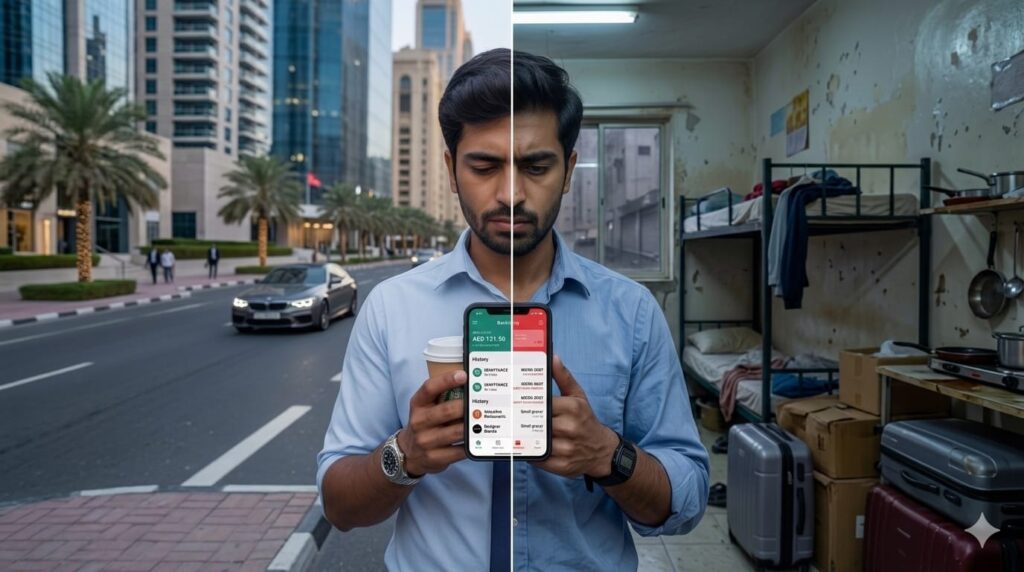
Rohan opened his banking app standing in his room at midnight — India was two and a half hours behind.
His salary had arrived 12 days ago.
After converting — his account showed the equivalent of ₹4,200.
He read the number twice and called his uncle back home.
He borrowed ₹45,000.
He felt a shame he hadn’t felt since the day he packed that plastic suitcase — the same quiet shame his father had carried into the bank on his daughter’s wedding day, pledging the very bricks he had spent 25 years building.
In that moment, alone in a Gulf room at midnight- Rohan understood what his father never got to tell him.
Gulf salary is a Mirage with a Deadline.From a distance,it looks like an ocean. Up close, it’s just sand.
The tragedy isn’t that the money is small. It’s that the Present Show consumes the Future Capital before the ink on the paycheck is even dry.
The Chakra was spinning.But it was spinning into everyone else’s accounts
THE NEO POOR TRAP
This is the Neo Poor trap.
Not poverty. Something more specific – and more dangerous – because it wears the face of a normal life
Educated enough to know the words – SIP, index fund, inflation, compounding. Employed enough to earn a salary that looks sufficient – especially converted to rupees. Aware enough to have started – Rohan’s ₹1,000 SIP was real, automatic, consistent.
And trapped anyway.
Because awareness without architecture is just expensive vocabulary.
The Notebook
The ₹45,000 moment changed Rohan. Not dramatically. Not with a sudden resolution.
Quietly- the way dawn arrives . You don’t see the exact moment the darkness leaves. You just notice the sky is different.
He opened a new notebook. Not his father’s — his own.
“Where does the money go?”
Three months of Gulf salary. One question. No complete answer yet.
But the question itself was something his father never got to ask in time. Something his grandfather never knew existed.
Rohan wrote it down at midnight in a Gulf room, twelve days after his salary, with ₹4,200 in his account and ₹45,000 borrowed from his uncle.
That was enough. For now.
What Your Parents Got Right
Rohan now knew the trap by name.
He could see lifestyle inflation in his spending history. He could see social pressure in his bank statements. He could see emergency vulnerability in that ₹4,200 balance on the 12th day.
But Rohan’s trap wasn’t a Gulf trap.
It wasn’t a Middle East problem or a first job in a new country.
Across India – in Bangalore apartments and Mumbai shared rooms and Chennai hostels and Hyderabad tech parks – a thousand versions of Rohan were staring at the same banking app on the 12th day of the month.
Different cities. Different salaries. Different lifestyles.
The Same ₹4,200.
On the 1st, you are a king.On the 15th, you are a commoner .On 25th, you are a ghost.
The Gulf youth.The indian city youth. It doesn’t matter where you are
The details may change — the phone upgrade, the restaurant bills, the weekend plans, the EMIs that felt like investments, the subscriptions that felt like necessities.
The trap doesn’t care about the details. It only cares about one thing:
That you spend everything before you build anything.
Buried between the old rules – gold, FD, land – was one principle that every generation had quietly followed without ever naming it.
It had kept his grandfather alive through droughts. It had kept his father solvent through twenty five years of desert heat. It had kept every generation before them from drowning in the river they were trying to build.
And it was the one thing Rohan – and perhaps you – had forgotten to carry forward.
In the next article — we find it.
Enjoyed this article? Share it with someone who needs to read it.
Share on WhatsApp: https://api.whatsapp.com/send?text=paisastories.in/neo-poor-trap-india
Share on Facebook: https://www.facebook.com/sharer/sharer.php?u=https://paisastories.in/neo-poor-trap-india