
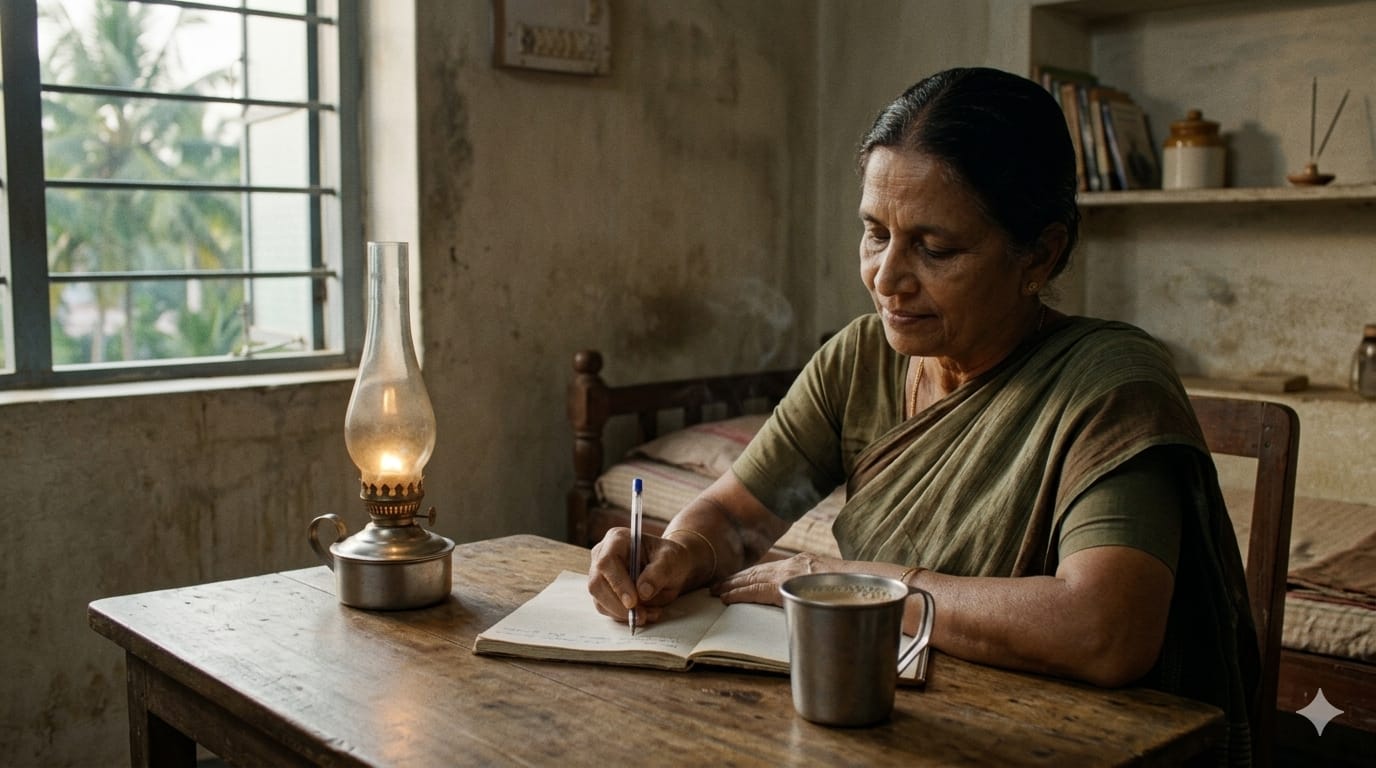
She Paid Herself First. For 35 Years. Nobody Noticed
“PAISA STORIES-WHERE SMALL THINGS CHANGE YOUR FINANCIAL REALITY”-PAY YOURSELF FIRST
In article 4, Rohan found himself educated, employed and broke – staring at ₹4,200 on the 12th day of his third salary. Few weeks after he came across a piece of paper that explained the most
Important thing he had been missing
The Dabba
The box smelled like home-dried chilies and coconut oil. His mother had packed his life into it: clean shirts, a dabba of homemade mango pickle, and a small, blurred photograph of the family.
To keep the pickle from leaking, she had wrapped the steel container in layers of an old, yellowing newspaper from their hometown.
Rohan almost tossed it into the bin. But as he smoothed out the paper, a small, three-paragraph obituary caught his eye. It was a tiny notice buried between a property listing and a school announcement.
He read it once. Then he sat on the edge of his bed and read it again.
The Woman Who Knew
The obituary was for Sudha, a woman who had passed away at 68.
She had spent 35 years as a playschool teacher in a town where the dust never quite settles. It was the kind of school where fees were kept low so ordinary families could afford it.
Her salary reflected that—it was a pittance, a fraction of what Rohan made in a week.
Her neighbors remembered her as “private.” Her colleagues called her “warm.” But the newspaper reported something else—something that had “stunned those who knew her.”
Sudha had left her entire estate to the school where she taught. The amount—described as “surprising to those who knew her”—made no sense for a playschool teacher. It was a number that defied the logic of her income.
Rohan put down the newspaper. Then picked up his phone. ₹4,200. Twelve days after his salary.
He sat with those two numbers for a long time.
The Notebook Contrast
Rohan opened his father’s notebook. He saw the architecture of a man who had survived, but never thrived.
The pages were a dense map of where Rahim’s sweat had gone: the fluctuating cost of cement, the rising rates for masons, the heavy invoices for wedding caterers, and the endless tally of household survival.
It was page after page of careful, painful accounting. Rahim had calculated the world’s needs with surgical precision. He had been a hero of sacrifice, but he had arrived at 55 with a ransom note where his legacy should have been.
Sudha had apparently calculated only one thing differently.
Pay Yourself First
Sudha started in the late 1980s. Her first instinct was a simple FD. But the magic wasn’t in the instrument; it was in the sequence.
Before the rent was signed, before the groceries were bought, before the world could ask her for a single paisa-Sudha paid Sudha. Non-negotiable.
When mutual funds became accessible, she moved her discipline there. No “expert” tips. No chasing the “next big thing.” Just a better engine for the same steady car.
In good years, when markets roared and everyone got greedy, she stayed quiet.
In bad years, when markets crashed and the world panicked, she stayed quiet. She just kept paying herself first.
The Math of Silence
Rohan ran the numbers. ₹1,000 per month. 35 years. 12% average annual return.
The total amount she actually took out of her modest salary over three and a half decades was only ₹4,20,000.
But because of the sequence, that small seed became approximately ₹4.9 crore.
Rohan felt a cold realization. His father, Rahim, had earned significantly more than Sudha every single year.
The difference wasn’t income, intelligence, or sacrifice. It was the sequence. Who gets paid first – determines who owns your life.
Rohan sat with those numbers for a long time.
What She Never Did
The obituary mentioned one final detail that Rohan had almost missed
“Those who knew her say she never once withdrew from her investments—not during the 2008 crash, not during personal difficulties, not once in 35 years.”
She refused to rob her older self to pay for her younger self’s “greeds.”
She didn’t treat her portfolio like a savings account; she treated it like a sacred trust. She spent thirty-five years teaching children their first words, only to earn her way to become the student of financial freedom.
Rohan Acts
That night, Rohan opened his own notebook. Beneath the question, “Where does the money go?”, he wrote a single, stinging answer: “Everywhere except for me. First.”
He opened his banking app. He didn’t wait for the next month. He restructured his SIP. ₹3,000-leaving his account on the 1st of every month.
Before the rent. Before the Gulf could take its share. He would live on what remained.
But one question still kept him awake.
The Missing Wall
Rohan had the principle, but he still had a fear.
If Sudha never withdrew—not once in 35 years—how did she survive the emergencies? The bad months? The unexpected invoices life delivers without warning?.
A playschool teacher’s salary is not large. Emergencies don’t check your income before arriving.
The answer exists. And it is the wall that makes “Pay Yourself First” actually work.
In the next article—we build it.
Enjoyed this article? Share it with someone who needs to read it.
Share on WhatsApp: https://api.whatsapp.com/send?text=paisastories.in/https://paisastories.in/pay-yourself-first/
Share on Facebook: https://www.facebook.com/sharer/sharer.php?u=https://paisastories.in/https://paisastories.in/pay-yourself-first/